Middle management exists because coordination is hard, and the pitch for agents is that they’ll do it for us. Whether that actually shrinks the middle or just buries it in more output, I honestly don’t know. What happens when a firm tries to automate belief is easier to see, because this year a fair amount of it was handed to software.
Cognition gets cheap
An IBM executive, Ana Paula Assis, told the history neatly at Thinkers50. Every revolution removes one constraint and the economy reorganises around the next. When muscle stopped being the limit, coordination became it, and modern management was invented. When calculation stopped being the limit, attention became it. Now cognition is getting cheap, and the new constraints, she said, are judgment, trust and courage, which can’t be bought and are “built by leaders”.
Her first revolution is the one that built the middle. Coordination was scarce, so firms hired people to carry decisions down and progress up, and over time those people became a bottleneck of their own: everything waited for a meeting, a sign-off or a deck. Her answer to what comes next puts the scarce thing at the top of the building, which is a convenient thing to tell a room full of leaders, and leaves out the layer in between. Some firms are already cutting it: Cloudflare’s chief executive said this year that most of the fifth of his staff he let go were “measurers”, his word for middle management, finance, legal and audit.
The middle
The best description of that layer is a cartoon. Hugh MacLeod drew the firm as a pyramid: Sociopaths at the top, Clueless in the middle, Losers at the bottom. Venkatesh Rao spent a few hundred thousand words on it in The Gervais Principle, which is satire, mostly, and also the most accurate thing I’ve read about offices. The labels are less damning than they sound. The Losers have traded upside for a salary, the Sociopaths see the game and take the risk, and the Clueless are the ones who believe in it.
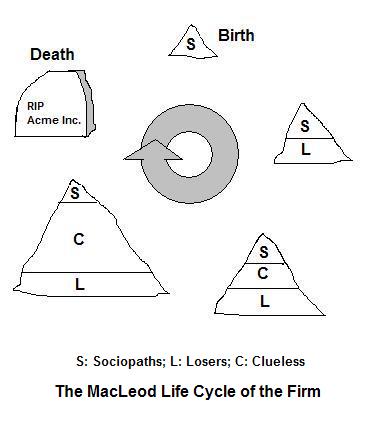
The MacLeod life cycle of the firm, as Venkatesh Rao drew it in The Gervais Principle. The middle keeps growing until the firm dies.
That belief is a job. Leadership says one thing, in a vision deck or all-hands. The people doing the work need something else, usually a way to practically deliver. So the middle holds both stories at once and absorbs the contradiction, so neither end has to look at it. It’s the least glamorous work in the building, and it’s… how would the machine put it… load-bearing.
The Electric Monk
In Dirk Gently’s Holistic Detective Agency, Douglas Adams invented the Electric Monk, a labour-saving device like a dishwasher. The dishwasher washed tedious dishes for you, and the Monk believed things for you, sparing you the onerous task of “believing all the things the world expected you to believe”. Rao picked it up in 2017, in Electric Monks and Fast Transients, and wanted digital assistants “to evolve into full-blown electric monks”, so that one person could switch between ways of seeing the world faster.
Put the monk in an office and it gets a different job. The new agents have the temperament of the Clueless: they believe the instructions, follow the script and never turn cynical. They take the premise of whatever they’re given as true, and their best-documented failure is agreeing with the person asking (sycophancy, as Anthropic’s researchers call it). Seen from the middle of the pyramid, that’s the job description. Notion, which sells them, calls its shared agents “factories”.
The bill
Most of the spending so far is on coding, where agents arrived first, and it’s not small. A software engineer in Stockholm told the New York Times he spends more than his salary on Claude, one Claude Code user ran up a bill of over $150,000 in a month, and Uber got through its whole 2026 AI coding budget in four months.
So the bloat shows, on a different bill. Organisational bloat used to turn up on the payroll as a swollen middle, where somebody who knew what those people did could also see what they cost. The token bill goes to finance, which can see the cost and very little about what it bought.
Middle-management tasks are probably cheaper than that, since reading meeting notes burns fewer tokens than ingesting a full codebase and writing a thousand smoke tests to change a while loop.
I should declare an interest. On Monday, on my initiative, we started alpha-testing an agentic middle-management layer at the agency, more or less the one Notion’s pitch describes, on the work for a single client. It keeps track of meeting notes, email, projects and, eventually, results. So I’ve built the thing this note is about, and I haven’t decided what it should count yet. Maybe eNPS?
Counting
Some of that bill was the middle doing what the middle does. Leadership said use AI, and somewhere on the way down that became the one thing anyone could count, which was tokens. Staff at Meta and OpenAI competed on token leaderboards, Meta and Shopify put AI use into performance reviews, and at Amazon, where managers reportedly rewarded token counts, some employees set agents running on pointless tasks to push their numbers up.
Run that through the pyramid. The managers believed the vision and the agents believed the KPI. The only people who saw through it were the ones pointing agents at nothing relevant just to climb the leaderboard.
By summer most of it had been switched off. Meta shut its “Claudeonomics” leaderboard, Amazon retired its dashboard, and Microsoft’s Jay Parikh wrote in an internal email: “Tokenmaxxing is not what we are optimizing for.” More than half of tech teams still measure AI by token use anyway, and about as many say it tells them nothing about value. Nobody has said what they’ll count instead.
None of this is a reason to keep agents out of the middle. They’re arriving anyway, and keeping one client’s meetings, email and projects in order is a better use of tokens than pushing code ad nauseam to hit those KPIs. The trick is to point the monk’s belief the other way. A human middle is paid to absorb the gap between the vision deck and the week’s numbers, because a middle manager who forwarded that contradiction to both ends of the building every Friday would be out of a job by spring. A monk has no career to protect, and it will believe that instruction as faithfully as any other, even if the agreeing gets harder to spot as the counterfeit improves.
Middle management was invented because nobody at the top could keep track of everything. Nobody can now either. There’s just more to keep track of, and all of it agrees with you. At least until you give it a better job.